
Food Security & Nutrition
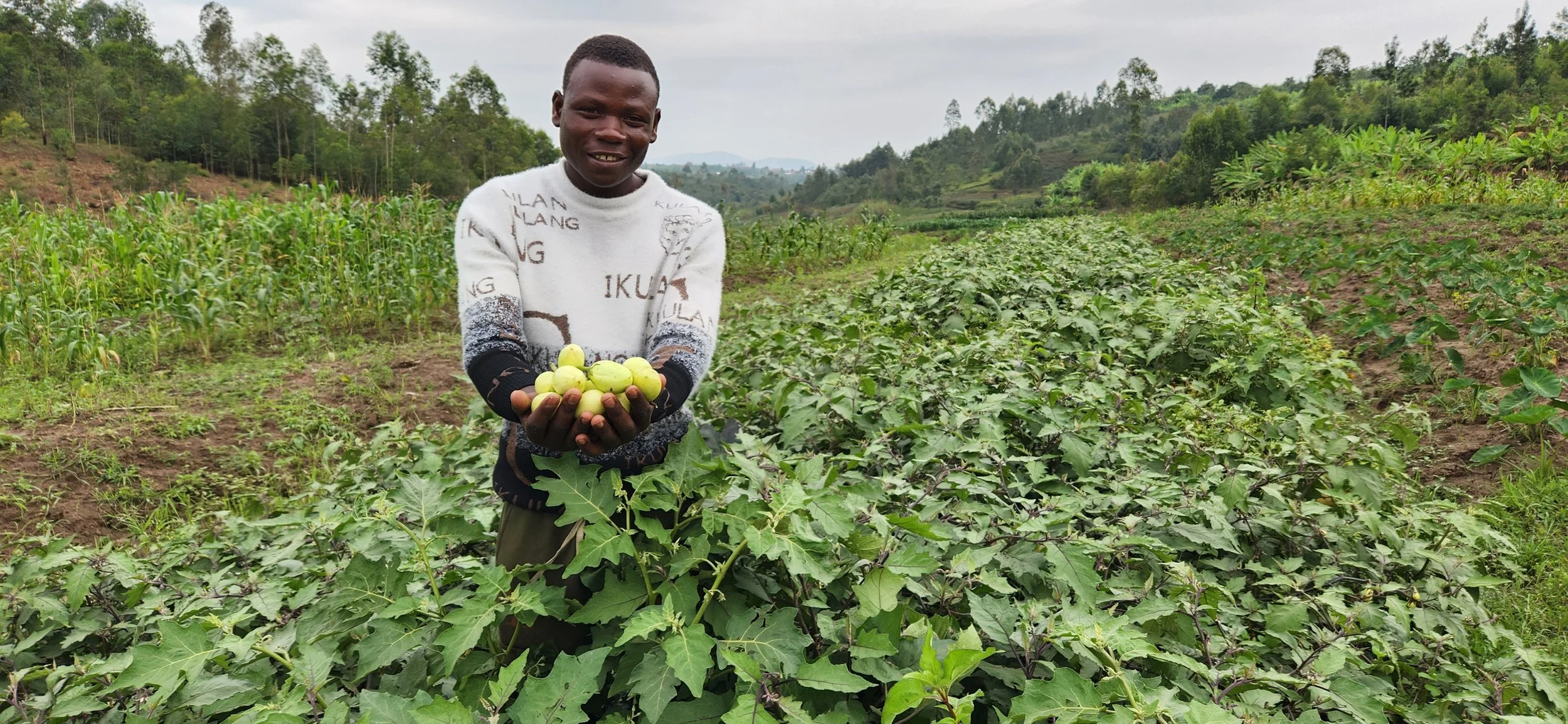
Zoe Rwanda Terimbere supports youth and other vulnerable people to move from hunger and food insecurity to reliable, dignified self-reliance through group-based, hands-on agricultural activities. Participants first join empowerment working groups where they learn how food production, nutrition, savings, and small businesses all connect to a stable household. Together, they assess their current situation, set targets for improved diets and harvests, and design simple plans that match their land, labour, and local markets. Over time, families shift from relying on irregular assistance, begging, or casual labour for food to producing and purchasing enough diverse food for themselves.
Demonstration Plots, Inputs and Practical Learning
Zoe Rwanda Terimbere begins by building very practical knowledge on how to “find their own food rather than begging, stealing or doing labour for food”. Through structured training on food security and nutrition, participants learn what it means to have sustainable sources of food, adequate quantity and good quality. Each household is encouraged to work towards clear standards: a stock of cereals, a plot of tubers, a stock of legumes, a kitchen or vegetable garden, fruit trees, and at least one type of livestock. Training sessions also cover how to plan and prepare healthy, balanced meals using locally available foods.
To turn this learning into action, Zoe Rwanda Terimbere supports groups to establish demonstration plots where participants learn by doing. In collaboration with sector agronomists, youth groups access unused public land that can serve as a shared field for land preparation, planting, weeding, mulching, and soil and water management; whenever government land is available, participants continue to cultivate it under a clear agreement with authorities. Where public land is not available, one member’s plot is used as the demonstration field so that new techniques are still tested in real local conditions. Zoe provides key agricultural inputs such as seeds, inorganic fertilizers, and pesticides for group agriculture projects, ensuring that households can immediately apply what they learn.
Training is reinforced by close collaboration with sector agronomists, who provide guidance on soil preparation, crop spacing, integrated pest management, and climate-smart practices suited to local conditions. Sessions combine theory with field practice on the demonstration plots and participants’ own land, so that youth gradually learn to diagnose problems such as nutrient deficiency, erosion, or pest outbreaks and to respond early rather than waiting for harvest losses. Strong relationships with agronomists also help youth connect to government programmes, improved seeds and ongoing technical advice beyond the life of the programme.
Climate-Smart Production, Kitchen Gardens and Diverse Diets
In the first year of the programme, Zoe Rwanda Terimbere and local agronomists work very closely with groups to establish solid foundations for climate-smart, diversified food production. Participants receive intensive training and on-farm demonstrations in improved methods such as mulching, intercropping, crop rotation, water-harvesting, and the balanced use of organic and mineral fertilizers. Together they design and plant household plots that combine staple crops with legumes, vegetables, fruits, and small livestock, so that families can access micronutrient-rich foods throughout the year and are less exposed to the failure of a single crop.
Kitchen gardens and fruit trees are a central focus of the first-year work. After joint training and live demonstrations, each household establishes its own kitchen garden near the home, planting a range of nutrient-dense vegetable varieties. Zoe provides initial and follow-up vegetable seeds, ensuring that gardens can be planted and re-planted without delay. Nutrition education is woven through these activities, helping participants understand what a balanced plate looks like for children and adults, why certain groups (such as young children and pregnant or breastfeeding women) need special attention, and how to store and prepare food safely. Families are encouraged to use part of their growing income to buy foods they cannot produce themselves, so that diets improve alongside harvests.
In the second year, the emphasis gradually shifts from direct instruction to strengthened ownership and consistency. Participants are encouraged to plan and manage their fields and kitchen gardens more independently, using the skills gained in the first year. Zoe Rwanda Terimbere and agronomists still visit groups for coaching, troubleshooting and refresher sessions, but households are expected to take the lead in replanting gardens, maintaining soil and water conservation measures, and integrating climate-smart practices into their own farm and business plans.
By the third year, the goal is that participants and their families are confidently sustaining these practices on their own. Participants organize their own seasonal planning, replant kitchen gardens using saved or purchased seed, maintain their trees, and continue applying climate-smart techniques without external prompting. ZOE Rwanda Terimbere keeps encouraging and monitoring progress, stepping in with targeted support only where necessary, so that by graduation families have fully adopted diversified, climate-smart production and can maintain improved diets and resilient farming systems long after formal support has ended.
Linking Crops and Livestock to Income and Self-Reliance
Zoe Rwanda Terimbere links crop production directly with livestock and income generation to create a strong, sustainable foundation for food security. In collaboration with government veterinary staff, groups receive training on livestock keeping, covering housing, feeding, hygiene, disease prevention, and the use of livestock insurance. ZOE then provides each family with small livestock such as pigs, goats or poultry, and participants often add more animals using profits from their businesses. Veterinary officers support the programme by vaccinating and treating animals, which protects this critical asset base and ensures a steady supply of livestock products.
As both crops and livestock become more productive, participants are guided to think beyond subsistence and plan with markets in mind. Group members design their fields and enterprises so that, after household food needs are covered, there is a surplus for sale. They receive support to calculate simple costs and profits, organize collective marketing and transport, and explore opportunities for basic value addition such as drying or basic processing. Savings and lending activities within the groups enable families to reinvest in quality seeds, tools, fertilizers and improved housing for animals, and to manage risks without resorting to predatory debt.
Step by step, households move from daily food insecurity to a situation where they can reliably produce and purchase the food they need, pay school and health costs, and continue investing in their future. The combination of demonstration plots, strong first-year support, growing ownership in years two and three, and integrated livestock and income activities allows youth and other vulnerable people to build a durable pathway out of extreme poverty, grounded in strong food security and nutrition that lasts beyond graduation.